An Interoperable Metadata Interface between DataPLANT and the Helmholtz Earth Data Portal
A central challenge in modern plant and life sciences data management is the isolation of richly annotated biological datasets from the geospatial and environmental data infrastructures that other disciplines depend on. Within the German National Research Data Infrastructure (NFDI), this gap is particularly evident between DataPLANT, which serves the fundamental plant science community, and the Helmholtz Earth & Environment (E&E) DataHub, the data infrastructure aligned with the NFDI4Earth consortium.
DataPLANT structures research outputs as Annotated Research Contexts (ARCs) [1]: Findable, Accessible, Interoperable, and Reusable (FAIR) [2] Digital Objects that package raw experimental data, metadata, analytical workflows, and computational results in a unified, version-controlled Git repository. ARCs adopt and extend the Investigation, Study, Assay (ISA) model [3], using tabular ISA-XLSX serialisations enriched with plant-science ontologies such as MIAPPE [4], alongside JSON-LD metadata representations via RO-Crate profiles [5]. Despite this rich semantic structure, public ARCs remain primarily discoverable within the DataPLANT ecosystem via the PLANTdataHUB [6], limiting their reuse by agronomists, crop modellers, geoscientists, data stewards, and environmental researchers who need to link plant phenotypic or omics data with spatial, climate, and soil variables.
The E&E DataHub provides cross-centre metadata harmonisation and discovery across Helmholtz research institutions via the Earth Data Portal (EDP): a web-based, openly accessible platform that supports federated metadata harvesting, faceted spatial search, curated thematic collections, and highly configurable data viewers. DataPLANT and the E&E DataHub can both be regarded as Data Spaces [7], each centred on shared standards.
Bridging these two data spaces is directly relevant to cross-domain objectives, as life science datasets increasingly require integration with environmental and spatial covariates for multi-scale analysis, predictive modelling, and cross-domain reuse.
A key barrier to this integration is the fundamental mismatch between the domain-specific ISA metadata schema used by DataPLANT and the geospatial metadata standards used by the EDP. The EDP harvests metadata through a variety of standardised interfaces and formats, including the Open Archives Initiative Protocol for Metadata Harvesting (OAI-PMH), catalogue services, and SpatioTemporal Asset Catalogs (STAC), and its discovery interface expects records carrying spatial and temporal extents. Such extents are rarely recorded in ARCs, and are not exposed through standard DataPLANT interfaces at all. Closing this gap requires a semantic translation layer that preserves the scientific richness of ARC metadata while conforming to the EDP’s spatial discovery requirements.
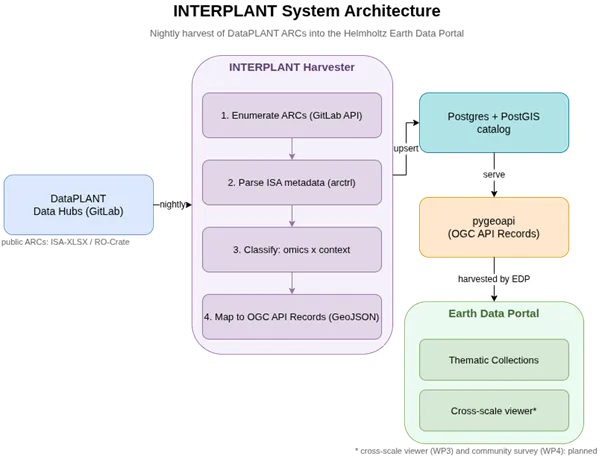
In the DataPLANT Community project, INTERPLANT, we have addressed this by implementing a translation pipeline. This approach involves the automated extraction of relevant spatial and temporal elements from ISA-formatted metadata, mapping ontology terms to recognised vocabularies, and converting the resulting records into formats that both a geospatial catalogue and the EDP can consume. The main steps are: parsing the ARC’s ISA-JSON or ISA-XLSX to retrieve fields such as geographic coordinates and observation periods; enriching metadata with ontology URIs; transforming the selected metadata elements to align with EDP’s target schemas; and publishing the output via a pygeoapi service endpoint in Open Geospatial Consortium (OGC) API Records (GeoJSON) format alongside an OAI-PMH endpoint for portal ingestion. This structured pipeline ensures metadata consistency, enables automated harvesting by the Earth Data Portal, and provides a replicable model for other domains seeking cross-infrastructure metadata interlinking.
Evaluating genotype–environment interactions is a core priority for modern sustainable agriculture: localised phenotypic observations must be assessed alongside regional climate pressures, such as the documented increase in atmospheric evaporative demand, which has shortened the growing season in European ecosystems over the last decade. The INTERPLANT project addresses this by creating a standards-based “Data Journey” connecting biological annotations from DataPLANT directly to the geospatial infrastructure of the Earth Data Portal, enabling interdisciplinary discovery, cross-scale analysis, and joint modelling across life and earth sciences. This contribution reports the implemented system, the outcome of a first harvest across the entire public ARC corpus, and the design assumptions that did not survive contact with the target infrastructure.
System Architecture
Section titled “System Architecture”To connect these data spaces without disrupting the internal workflows of either consortium, INTERPLANT implements a standards-compliant, automated metadata-harvesting pipeline built around one record store with two public interfaces. First, a scheduled harvester extracts metadata from public ARCs, maps it to our record schema, and updates a PostgreSQL and PostGIS database daily. Secondly, an intermediate catalogue service based on the OGC API Records standard exposes those records for spatial query and reuse, while an OAI-PMH endpoint serves the same records to the EDP for harvesting. The EDP integrates the resulting geolocated plant datasets seamlessly alongside geoscientific, atmospheric, and hydrological records from across the Helmholtz network.
At the core of the pipeline is a semantic translation mapping that extracts spatial and temporal metadata — such as the geographic coordinates of experimental sites, observation periods, and dataset extents — from the ISA-JSON/XLSX schemas of each ARC. Every record is validated against a published JSON Schema before storage, and each harvest run writes a machine-readable audit artifact. The catalogue records comply with the API Records standard, a modern, resource-centric catalogue specification that uses GeoJSON as its primary encoding and supports advanced querying using spatial bounding boxes, time ranges, and free-text attributes. They are served via a customised instance of pygeoapi, an open-source Python reference implementation of the full OGC API suite.
Metadata Harvesting and Ontology Use
Section titled “Metadata Harvesting and Ontology Use”The metadata harvesting pipeline is ontology-aware, extracting not only descriptive fields such as titles and abstracts, but also the structured ontology term annotations embedded in each ARC’s ISA-XLSX tables via the Swate annotation tool. This tool draws on a curated set of community-endorsed ontologies, including the DataPLANT Biology Ontology (DPBO), the Ontology for Biomedical Investigations (OBI), the Environment Ontology (ENVO), the Minimal Information About Plant Phenotyping Experiments standard (MIAPPE), the Plant Experimental Conditions Ontology (PECO), the Plant Trait Ontology (TO), the Plant Ontology (PO), the Chemical Entities of Biological Interest (ChEBI), the NCBI Taxonomy (NCBITAXON), and the Ontology of Microbial Phenotypes (OMP). The harvester preserves these ontology term accession numbers and source references, mapping them to the themes field in OGC API Records via SKOS concept URIs. This partially preserves the semantic richness of ARC metadata in the catalogue layer. However, the OGC API Records standard does not natively support the biological metadata dimensions that are central to life science data discovery. To adequately represent biodata in the EDP, the metadata schema will therefore need to be extended through the definition of a life-science application profile, e.g., building on the Bioschemas Dataset and Study profiles or a dedicated DCAT-AP extension. This would expose these biologically meaningful fields alongside standard spatiotemporal extents.
The DataPLANT DataHUB hosts ARCs from a growing range of life science disciplines beyond fundamental plant science. For example, ARCs from the DFG Collaborative Research Centre MibiNet (Microbial Networks) capture microbial datasets annotated with OMP and NCBI Taxonomy. Additionally, plant datasets can be derived from controlled experiments and lack georeferenced spatial extent. Many ARCs on the DataHUB lack the bounding-box and temporal-extent fields expected by the EDP’s discovery interface. The OGC API Records standard permits a null geometry value, but the EDP’s map-based search and faceting risk marginalising datasets without coordinates. The INTERPLANT pipeline therefore implements a graceful strategy for non-georeferenced records, for instance, by deriving an approximate administrative bounding box from the institution’s location metadata, or by flagging records with a controlled-vocabulary tag indicating the absence of precise spatial information. This ensures that the full breadth of life science data on the DataHUB remains discoverable within the EDP without misrepresenting spatial specificity.
Spatial Visualisation and Curation
Section titled “Spatial Visualisation and Curation”Once indexed, DataPLANT datasets are presented within the EDP’s “Collections” framework, which allows thematic grouping of related metadata entries by research initiative, transregional project, or crop species. Dedicated landing pages for each collection provide rich contextual descriptions, links to associated publications, and direct references back to the source ARCs on the PLANTdataHUB. This increases the visibility, citability, and scientific profile of plant research outputs, making them discoverable to a broad interdisciplinary audience. Geolocated experimental data is extracted from ARCs and exposed via standardised OGC web services (WMS, WFS) and GeoJSON feeds, which the EDP’s configurable viewer framework can consume directly. An interactive cross-scale demo viewer is developed within the EDP that overlays localised crop phenotypic records with satellite-derived remote sensing products. This enables crop modellers, agronomists, and earth scientists to explore genotype–environment interactions across spatial and temporal scales in an accessible, web-based environment.
Conclusion and Future Outlook
Section titled “Conclusion and Future Outlook”INTERPLANT shows that standards-compliant metadata interfaces can be a scalable, non-invasive, and cost-effective approach to eliminating technical barriers between life and earth sciences. By developing a reusable harvesting pipeline and OGC-compliant catalogue service, together with an OAI-PMH endpoint for portal ingestion, the project makes plant research data in DataPLANT ARCs discoverable and visualisable within the Helmholtz Earth Data Portal — without requiring changes to existing tools or repositories on either side. The implementation runs under 223 automated tests.
The architecture developed here is explicitly designed as a cross-consortia blueprint. Other NFDI communities, including FAIRagro for agricultural data, can adopt the same integration pattern to connect their data spaces to the EDP with minimal additional effort. By releasing all software as open source and grounding every component in community-endorsed standards recommended by NFDI4Earth, INTERPLANT provides a lasting, maintainable foundation for cross-domain data harmonisation across DataPLANT, NFDI4Earth, and beyond.
The source code currently sits in an institutional repository pending release review and will be published under an open licence; until then, readers who would like access can contact the authors.