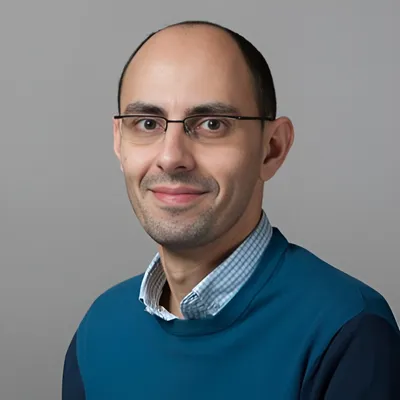
Keywan Hassani-Pak
Keywan Hassani-Pak, Head of Bioinformatics at Rothamsted Research and Founder/CEO of KnetMiner Ltd., has over 15 years of experience in integrative bioinformatics. His work focuses on turning massive, fragmented multi-omics data into actionable discoveries for crop improvement. He is the lead architect of KnetMiner, an open-source gene discovery platform that uses advanced knowledge graphs and AI to scan millions of relationships in biological databases and literature. This software allows researchers to intuitively explore hidden genetic networks behind complex plant traits. Dr. Hassani-Pak advocates for evidence-based hypothesis generation, integrating FAIR data principles with modern AI to accelerate candidate gene discovery and drive sustainable agriculture innovations.
Can a Machine Have a Good Idea? Hypothesis Generation at the Fusion of Knowledge Graphs and AI Agents
Section titled “Can a Machine Have a Good Idea? Hypothesis Generation at the Fusion of Knowledge Graphs and AI Agents”We have taught machines to retrieve, to summarise, and to converse. The harder question — the one that matters for science — is whether they can help us have ideas worth testing. When a large language model invents a plausible but unsupported connection, we call it a hallucination. But set aside the loaded word and look closely: a plausible, previously unseen or overlooked connection is often the starting point of a hypothesis. The difference between a dangerous hallucination and a valuable hypothesis is not the act of imagination, but whether it is traceable, testable, and anchored in evidence. This is what the fusion of knowledge graphs with LLMs and autonomous agents makes possible. The graph supplies grounded, connected biology between genes, traits, pathways, and publications, with varying degrees of certainty. The agent supplies reasoning: it plans, traverses, and calls external tools, assembling chains of evidence across species and omics layers. The language model supplies the imaginative leap — but a leap now tethered to what is known, and accompanied by its own workings. Drawing on our work with KnetMiner and pan-genomic multi-omics knowledge graphs, I show how we build and index knowledge graphs and how graph-grounded agents move biological discovery from keyword search towards genuine hypothesis generation — proposing candidate genes for crop traits and disease resistance that are transparent, evidence-linked, and falsifiable rather than merely fluent. I will argue that the aim is not to automate the scientist, but to build them a tireless collaborator: one that reads everything, forgets nothing, and dares to connect the dots that we cannot.
