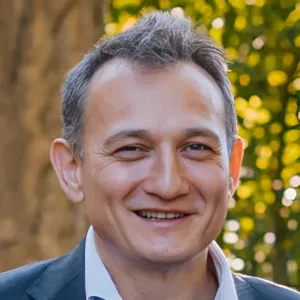
Can Türker
Dr. Can Türker is a leading database systems expert and the Head of Data Management at the Functional Genomics Center Zurich (FGCZ), a joint state-of-the-art research facility of ETH Zurich and the University of Zurich. With over 30 years of deep academic and industry experience specializing in extended and object-relational database systems, he is the author of several foundational textbooks in the field of data engineering. For the past two decades, Dr. Türker has applied this rigorous computer science expertise to the life sciences as the inventor and lead architect of B-Fabric. This unique, highly advanced data integration system is custom-built to tackle the complexities of massive Multi-OMICS research. B-Fabric seamlessly captures and links the entire lifecycle of biological data—from initial project design and physical sample tracking to instrument data generation and downstream computational analysis. By bridging the gap between hardcore database theory and practical bioinformatics, Dr. Türker’s pioneering infrastructure work exemplifies how robust, long-term system architectures can operationalize FAIR principles and enable reproducible, large-scale systems biology.
The Loom of a Modern Life Sciences Core Facility: Stitching Instruments, Data, Science, and Business Together
Section titled “The Loom of a Modern Life Sciences Core Facility: Stitching Instruments, Data, Science, and Business Together”A modern life sciences core facility is not one machine but many: sequencers, mass spectrometers, and computers, each producing its own stream of samples and files. Layered on top are the humans — researchers with questions, technicians running protocols, and administrators tracking cost centers and turnaround times. Left unmanaged, these threads tangle: data get orphaned from the samples that produced them, instrument time gets decoupled from the science it’s meant to serve, and billing becomes a forensic exercise rather than a byproduct of the work itself. This talk explores how a core facility can weave these threads into a coherent fabric rather than a pile of loose ends. Drawing on two decades of experience building and operating B-Fabric, it will show how a single information platform can connect the various facility operations: linking samples to instruments to results, automating the handoff between wet-lab work and computational analysis, and making business processes — orders, workflows, invoicing — a natural extension of the scientific record rather than a parallel bureaucracy.
